
We’re All in One Digitized Canoe
Creators & Technical Experts Share Fate in the AI Economy

In my last article, I argued that those categorized as “creators” (or sometimes “creatives”) and those with domain expertise in fields without such labels and share a common interest in the AI economy. Musicians, painters, photographers, actors, writers, and other “artists” all have domain expertise reflected in their creative style expressed through their collective works and the methods they used to create those works.
Ok, fine. So what? What does Stack Overflow’s decline have to do with artists who are being displaced by AI image generators or musicians being put out of work by Suno or Udio? Why lump creators in with technical domain experts?
In the AI Economy, We Are But Data Sources
From an AI model builder’s perspective, if I want to build a system that can replicate these creative styles, I need a lot of training data, i.e. artists’ works. Similarly, if I want to build a system that can write computer programs, I need a lot of training data, i.e. programmers’ code. If I build these kinds of systems, I can dramatically lower the price and speed of access to each kind of expertise, disrupting these existing markets and attracting customers and capital alike.
What is the source of training data for AI systems? Technical domain experts create insight from data. Creatives inspire insight through their stylistic choices. More that just raw data is needed to train AI models. Insight is needed. Context is needed. As AI labs pursue “AGI1”, they need not just the raw data, but the synthesis of that data through the application of expertise in context.
Looking again definition from last time:
Domain expertise is specialized knowledge, creative abilities, and practical skills that traditionally commanded premium prices due to their scarcity and the significant time, talent, or experience required to develop them.
The work product of some domain experts, like software engineers, exists in the digital domain by default. Others, like musicians, visual artists, or writers, have moved to the digital domain because their audiences have moved there. In both cases, most publically available digital work products have been incorporated into AI models already.
Disruption in the Expertise Supply Chain
AI innovations have created disruptive differentiation by offering access to many kinds of expertise faster and cheaper than existing solutions (i.e. human experts, hours of “doing your own research”, etc). Demand is increasing for domain expertise (see Jevon’s paradox) even as economic price plummets. This may also feel like a surge in supply (oversupply!), but this is the counterintuitive piece: the supply of domain expertise is being reduced2.
Why? Back to Econ 101: when prices fall, the amount of supply in the market decreases to the level the market price can support. The rapid rise in the capability of AI models has increased the elasticity of previously inelastic kinds of expertise.
Perhaps you’ve noticed the job market for software engineers has been pretty terrible over the last 18-24 months. For software engineers who entered the job market post early 2000s dotcom bubble burst, the last 2 years may have been the worst since the subprime mortgage crisis of 2008.
But the current AI era is just the most recent in a long, sordid history of disruption to creative fields. We don’t have to look too far back for a notorious example.
The Napster Disaster
In the early days of internet file sharing and MP3-encoding, the file sharing site napster.com was the most well-known place on the internet for finding and downloading music MP3s for free. As someone with disposable income inversely proportional to the size of my rock & roll dreams at the time, I didn’t have much sympathy for James Hetfield and the Metallica boys who were calling this out as piracy. After all, people were listening to their music, right?
Well…I’ll forgive myself for being a bit naive and missing a strong market signal that I would find becoming a professional musician very difficult.
Here’s question I often find myself asking others when discussing the AI economy because the answer startled me when I became aware of the answer.
When did the US music industry finally reach record revenue again after the decline during the Napster era?
The answer? Depends a bit on how you count, but according to the Recording Industry Association of America’s data the answer is not until 2021.
Declines began in 2000, bottomed out in 2014, and have been rising on streaming revenue since. Note the mid ‘00s to mid ‘10s era. The kludgy and short-lived paid digital download model gave some relief, but not until recently has the industry actually returned to real dollar growth. Adjusted for inflation, it’s still only at about 65% of where it peaked in 2000.
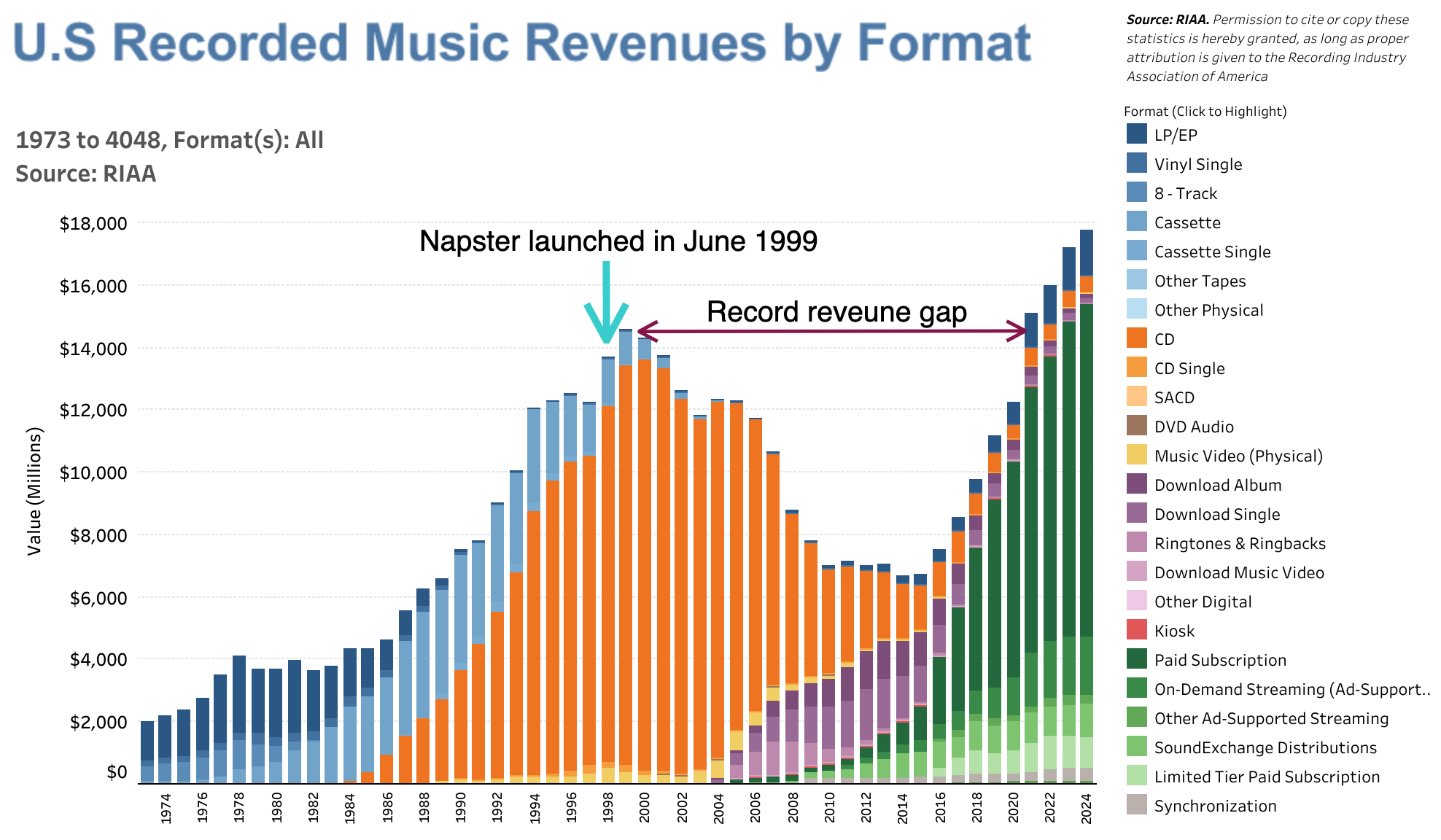
After a brutal 2 decades and tenuous, market-forced relationships with new tech partners, the music industry will need to prepare for the next wave of disruption. It seems it is finally starting to wake up a bit with a few lawsuits filed by large catalog owners prompting some closed door licensing negotiations.
In recent news, a new competitor to Suno and Udio has entered the market. ElevenLabs AI Music Generator partnered with 2 large independent music catalog owners (Merlin Network and Kobalt Music Group) to build their model from properly licensed material. By compensating the domain experts who provided the training data for their model, they’ve not only demonstrated a more ethical path than the “ask for forgiveness and a licensing deal (later), not permission” approach that most commercial model builders have employed. They’ve also shown there is an emerging market for this catalog of music/data, which should encourage others to participate. As model vendors compete on quality, the need to better curate that data is also emerging.
How Digitized is Your Expertise?
Things like text, music, video, images, and code are the things we’ve seen front and center in the rapid digitization of the world, but most domain expertise is not so readily captured and visible. Many domain experts have deep knowledge of a narrow space that is not well captured in digital form today, at least not in a way that can easily be used to train AI models. Even if your main work product is one of those listed above, it’s unlikely that the context you created that work within was well captured. Considering what’s at stake in the AI economy, however, you should assume that someone is trying to capture that knowledge and decide how to respond, no matter what your area of expertise.
Context is always changing.
This means that no matter what AI models have already trained upon, they will always lag behind in access to context. They will continually need new data that exists within present contexts to maintain their performance on expert-level tasks.
Analogously, the music business is no longer facing the existential threat of digital music downloads. The context has changed. The barrier of access to music has been reduced such that the inconvenience of downloading music, even if it were free, is no longer seen as desirable to most consumers. New threats are emerging in the new context, but we’ll save that for a deeper dive in another article.
Bottom Line: Time to Start Paddling
Both technical domain experts and creatives whose work outputs are often publicly available in digital form on the internet are being treated the same way by most AI labs (i.e. not being compensated for their work), despite being a critical part of the AI model supply chain.
Domain knowledge, expertise, and creative style are the raw materials that AI labs process to deliver their end products.
The question for all domain experts becomes “How do I negotiate a better price than “free” for the raw materials I have to offer?”
For experts, there are many strategies to consider, but they all boil down to one choice: Ensure your expertise remains both scarce and relevant, such that you can charge a premium for it; or curate the training data set yourself and find the right buyers. Making the right choice depends on many factors, some of them related to the nature of your expertise, and others related to the state of AI tech. I’ll dive into this choice in future articles. That’s all for now.
There’s no consensus definition of AGI (artificial general intelligence), so largely this talk of it “coming very soon” is a mix of ambitious, terrified, and narcissistic folks putting a marketing polish on the reality that they really don’t know.
While some research has shown that regular use of AI assistants can reduce critical thinking abilities in humans, that’s not the argument I’m making here.