
Are You a Domain Expert? Probably.
Defining Domain Expertise for the AI Economy

A central topic being interrogated through my writing here is the value of domain expertise in the AI economy and how AI systems have disrupted the supply chain of domain expertise at an unprecedented scale.
Defining “Domain Expertise”
It’s been convenient for me to put out a few pieces and throw around this term as if it’s well understood, but I’d like to get more precise about this terminology to offer readers more clarity. I’ve been using quite a few terms synonymously:
Domain expertise
Domain knowledge
IP (intellectual property)
Creative style
Know-how
Subject matter expertise
These are not new ideas and have been fairly well-defined and understood for a long time, but they are not synonymous. Creative style is very different from subject matter expertise in nuclear physics, for example. You might even say we’re comparing apples and oranges. But in the context of the AI economy, where all these apples and oranges are being consolidated into AI models and made ubiquitously available to the general public for relatively cheap monthly software subscriptions, they are really all part of one big bowl of fruit salad.
To make things more concrete, I’ll start with a long-winded definition. Over time, through more careful examination and reception of some tomatoes in the face, I’ll simplify it down to a more fundamental form:
Domain expertise is specialized knowledge, creative abilities, and practical skills that traditionally commanded premium prices due to their scarcity and the significant time, talent, or experience required to develop them.
This encompasses all forms of knowledge and capability that add value between raw information and actionable solutions—from technical subject matter expertise to creative expression to hands-on know-how—regardless of traditional field boundaries.
These are the very capabilities that AI systems are now consolidating and commoditizing, making them widely available at low cost and disrupting the established supply-demand economics that previously sustained expert-based business models.
Supply Chain Impact Unifies a Common Class
This broad definition is designed intentionally to include a very broad set of concepts. Similarly, the group of people who should be considered domain experts, those who possess domain expertise of some kind, will be correspondingly broad. Whether a plumber with 30 years of experience serving residential buildings on the north side of Chicago, a painter with a distinct surrealist style inspired by exposure to war zone conditions as a child, a sports medicine doctor working with professional triathletes, or a software engineer with a decade spent migrating a legacy code base into a modern architecture, each individual will have developed a unique perspective. Each will have some market for that perspective, some being larger than others. Some perhaps vanishingly small except for the right niche audience.
This industrial-scale consolidation and commoditization of expertise impacts domain and subject matter experts, IP owners, creatives, inventors, tradespeople, and really anyone with a valued point of view or niché skills born from experience in a common way. The price of expertise is being driven down rapidly by AI systems such as ChatGPT. Nearly all of these systems are trained on vast data sets of questionable provenance, which turns out to matter a lot for those whose previously monetizable work has been incorporated into those data sets without consent or compensation.1
The Supply Chain of Expertise
Consider how experts monetized their expertise in the pre-ChatGPT era2. Very complex questions required domain experts who could charge a premium for answers. The less complex the question, the greater the supply of people who could provide the answers.
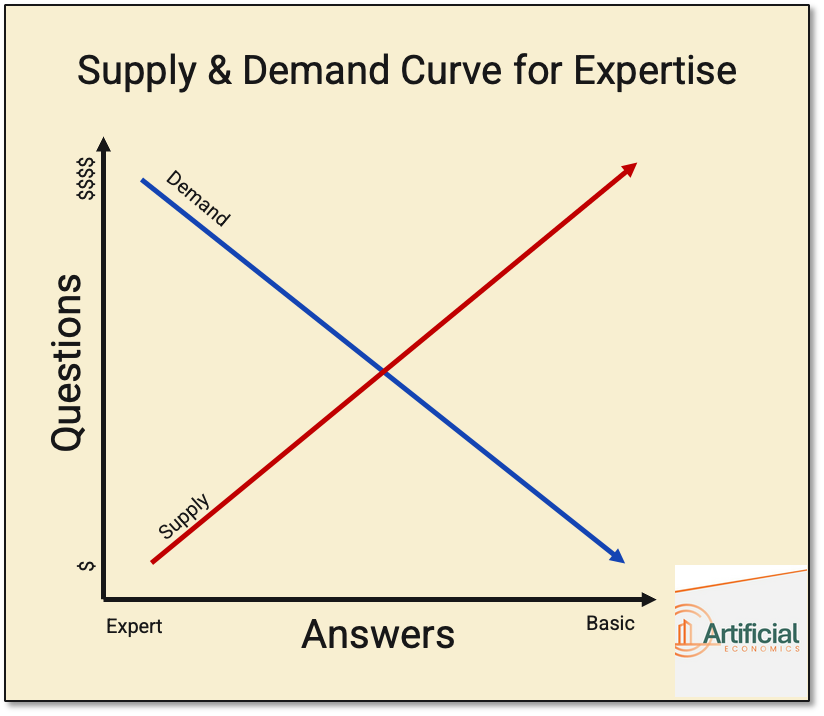
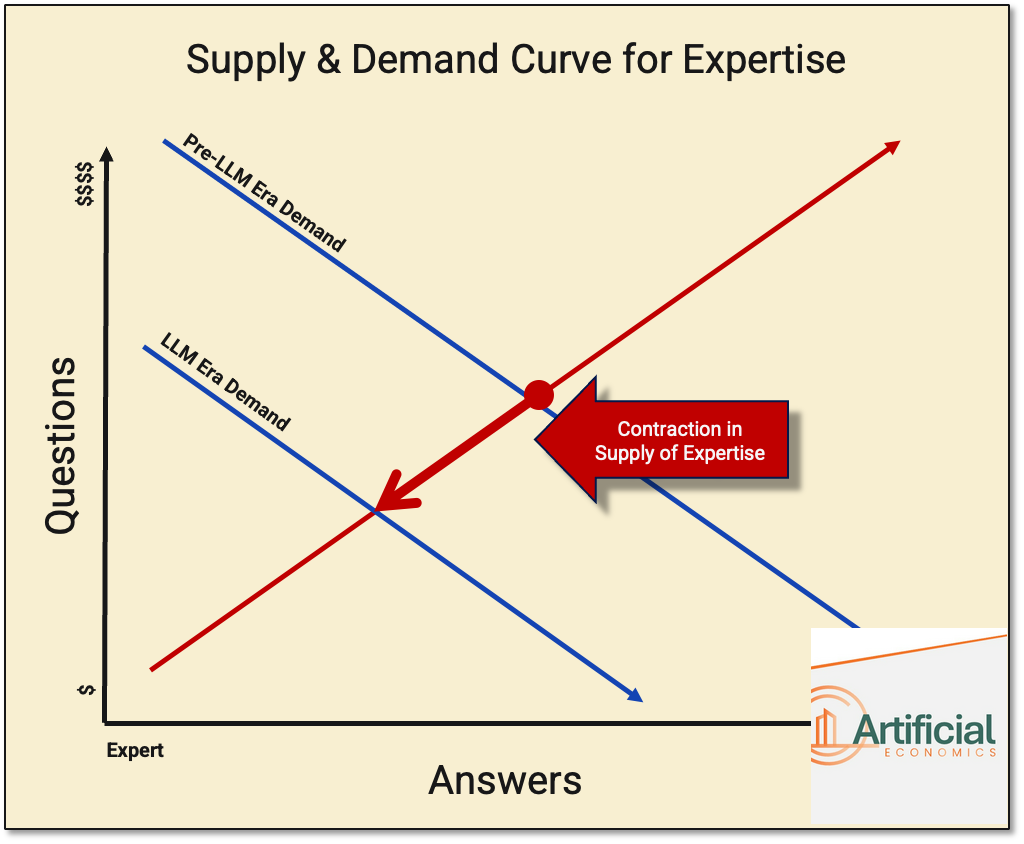
With the rise of LLMs, the demand (call it “willingness to pay” if that helps) for expertise has been significantly reduced. People can just ask ChatGPT (or Claude, etc) questions for which they used to need to seek out an expert. This reduction in demand for “human hosted expertise” has an unfortunate side effect. As the demand for expertise goes down in terms of absolute dollars, the amount of supply contracts. Suppliers (experts!) exit the market as it becomes less and less sustainable for all but the most efficient operators.
If you’re skeptical about this, consider the case of Stack Overflow, an online watercooler, crowdsourced knowledge base, and one of the most commonly used online resources for software engineers in the pre-LLM era. As I learned from an article published by The Pragmatic Engineer, Stack Overflow is Almost Dead:
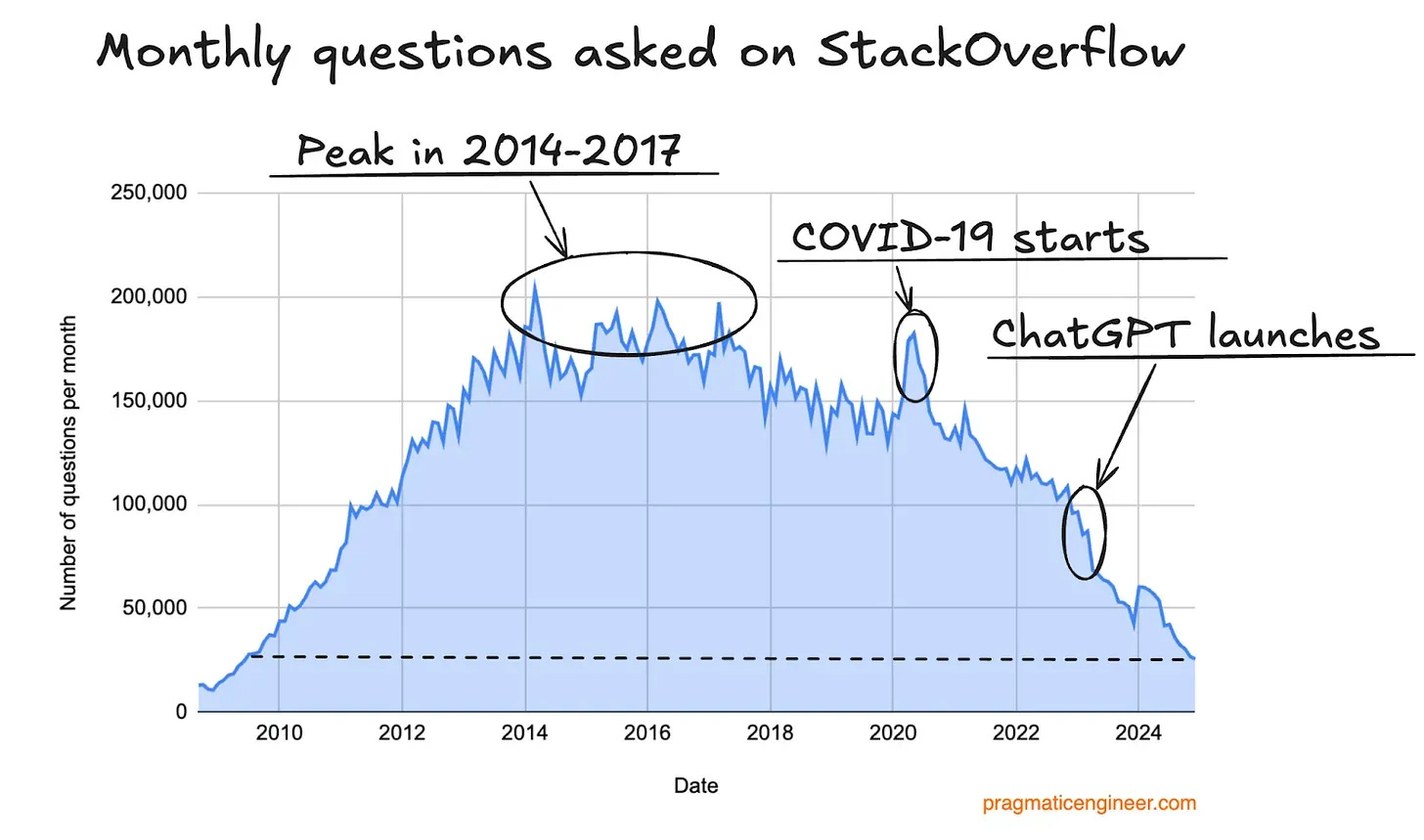
Note here that this isn’t a graph of the questions answered on the site, it’s a graph of the questions asked. The demand for expertise, at least in the crowdsourced Q&A format offered by Stack Overflow, has seen a catastrophic decline.
Now, to be clear, demand for the expertise being sought on Stack Overflow didn’t disappear. Buyers found in ChatGPT and other AI tools an option that served their need for expertise a tool that was significantly better. Rather than post a question and wait for a reply, one could ask a question and get a nearly instant answer. It didn’t help Stack Overflow that their entire site was scraped for training AI models, so any question already answered somewhere on the site would also be answerable by ChatGPT. If a question wasn’t answered directly, but one could assemble several pieces of existing knowledge to get an answer, searching the website would take significant time. AI chatbots could find and assemble the relevant information from within its own training corpus in just a few seconds.
Like It or Not, It’s Just Better (as a User)
Whether you’re a believer or skeptic on AI, it’s just a fact that the GPT-4 class LLMs all offer a vastly superior user experience for searching for information on the internet3, especially when enhanced with agentic research and reasoning functionality. Searching the internet was revolutionary as the internet emerged as an “information superhighway”. But the process of first picking the right search terms, then scouring the returned links, following them, and manually scanning websites to try to find what you’re actually looking for seems archaic in contrast to being able to ask your question in natural language to Claude and getting near immediate answers.
One reason Google is so heavily invested in (and hyping) AI is because it recognizes the threat these tools pose to their core search business. It’s why you get an AI generated summary at the top of your google search whether or not you want it. Hey, it’s better than a solid a page of sponsored links.
Supply Chain Disrupted
The incredible speed of access to information, knowledge, and expertise provided by LLM-based AI systems has had the effect of dramatically lowering the cost (time and/or money) for individuals to access it. This is not the first time the expertise supply chain has been disrupted. Just as the rise internet of the internet disrupted existing expertise-based business models with a 10x better way to acquire knowledge from the comfort of home, so too has the rise of AI with a 10x better way to sort through all that available knowledge and summarize what’s most relevant.
But beyond just “knowledge”, AI models have also been incorporating “style”. LLMs are able to reproduce the writing styles of authors with enough training material. Audio models, similarly, are showing the capacity to reproduce the styles of musicians and even the likeness of singing voices. Image and video generators are able to create stylistically dead-on impressions of artist and filmmaker styles.
Next time, I’ll get into how past disruptions in the music business compare and contrast with the disruption AI is having on the industry today in an effort to convince you, dear reader, that creatives, technical domain experts, and anyone with IP or unique perspective are in the same canoe in the AI economy and will benefit from sharing the best ways to protect the sovereignty of our expertise.
Full disclosure: I use AI models with questionable provenance every day. My goal here is not to stack up soap boxes upon soap boxes of moral superiority. I’m seeking to increase the level of nuance in the discussion of the impact AI has on “the supply chain of expertise” as the economy shifts in reaction to disruption.
I’m sure my use of this supply & demand curve will make real economists squirm in their coffins, but hopefully it still conveys my meaning.
Note that this claim is limited to the specific task of searching the internet for knowledge or expertise, not a universal claim about AI generally.