
Revisiting "The Emperor's New Clothes" in the AI Era, Part 1
Great Business Book or Greatest Business Book?

If I ever end up in a conversation about books on business, entrepreneurship, or consulting I’ll almost certainly start talking about one of my favorite’s of all time: “The Emperor's New Clothes” by Hans Christian Andersen, perhaps one of the great business writers of the 19th century.
As far as I know, it’s one of the first works on consulting best practices, one so many consultants have been riffing, remixing, and basing our own frameworks upon in the nearly two centuries that have followed.1
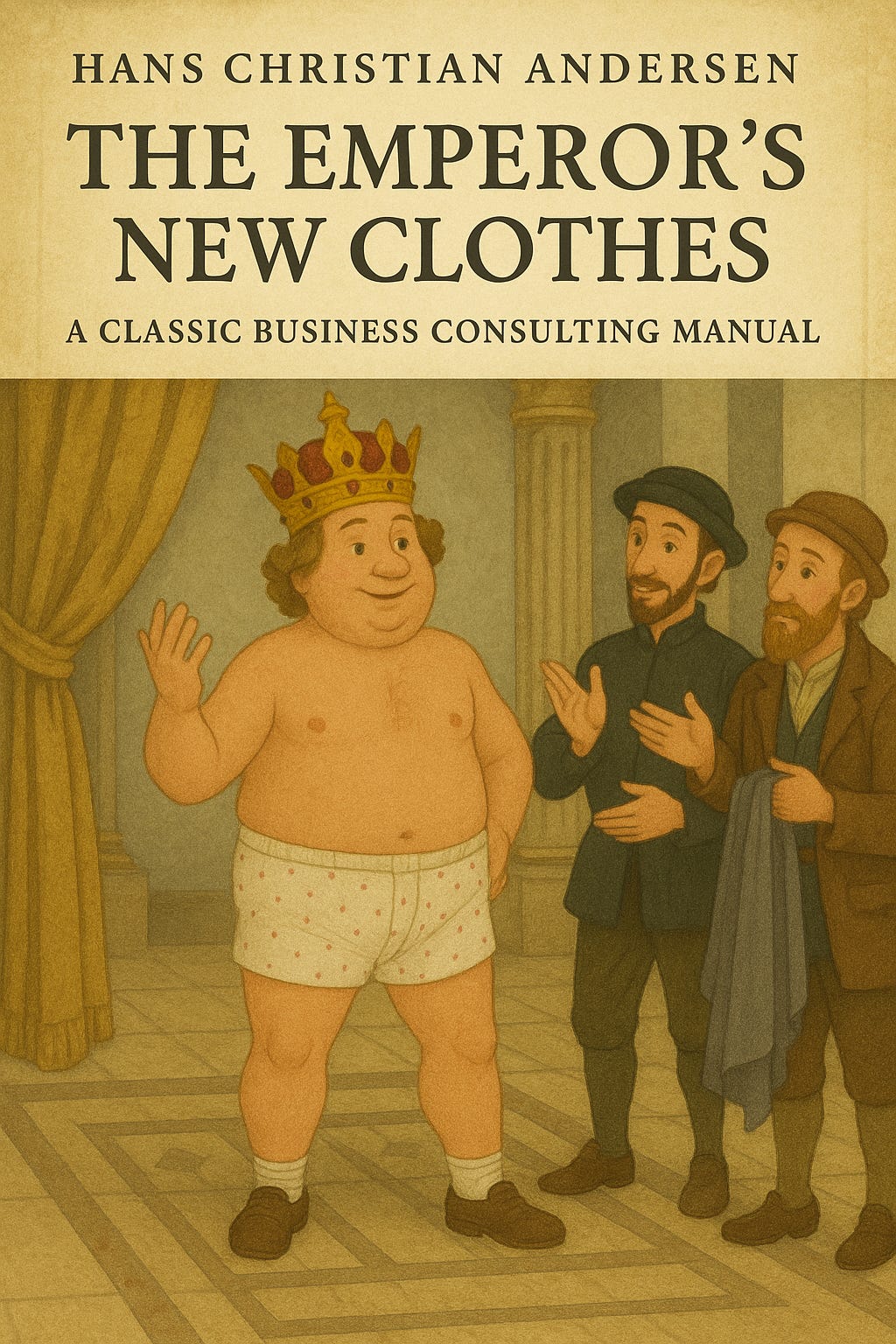
Perhaps you recall the bones of the story, but I encourage you to read or listen to it again as a refresher. It is now in the public domain, so it is freely available to read or listen to on websites such as this one. I listened to it on Audible and its free if you have any kind of plan.
But in case you’re not gonna go do that right now, here’s my own rough paraphrase:
There’s an emperor who likes to dress up in fancy outfits, get paraded around town, and receive praise from the citizens.
One day, a couple consultants from out of town tell him they’ve seen fancier outfits with a lot of their other clients.
They tell him they can make him one if the emperor can pony up a couple spools of gold thread in advance.
The guys also tell him that the clothes are so fancy that they’d be invisible to anyone falling behind peers in their roles and stuck on “legacy thinking”.
The emperor was seeing the bigger picture. It wasn’t just an outfit, it was tool; An opportunity to gain advantage over adversaries and allies alike.
He gives them the gold thread and tells them to begin the work. But the emperor is no fool, of course.
He has his Chief of Staff and his Chief Fashion Advisor check in on the work, each independently.
After a few days, the emperor’s Chief of Staff checks in and see the consultants fiddling with the spools of gold, but doesn’t see the outfit.
Suspicious, but unfamiliar with the technology and fearful that he may be stuck in legacy thinking, he gives a positive report back to the Emperor. “Everything is on track for end of week delivery, dear Emperor!”
Two more days pass and the Chief Fashion Advisor drops in on the consultants. Noticing the spools of gold thread looking fairly depleted, he asks if the outfit is nearly complete. “No issues,” the consultants reply.
The advisor barely admitted to himself that he couldn’t see the outfit, and didn’t dare admit it to anyone else. He suspected he was falling behind his peers in other empires, but now that belief had been validated by outside consultants!
Without his own point of view the Chief Fashion Advisor borrow’s the consultants’ confidence. “This innovative outfit will truly reinvigorate your wardrobe, unquestionably!”
Finally, the weekend rolled around and the emperor went to pick up his new threads from the consultants’ office.
Strangely, the emperor saw no gold thread and no outfit, but the consultants were behaving as if they were presenting something to him and his advisors looked on assuringly.
“Here you are emperor! The finest and most innovative outfit in all the lands! Of course, you’ll notice that despite its extravagance, the golden fabric is so light its weigh is imperceivable on the wearer. Shall we help you put it on?”
“Um, yes…assuming my advisors still agree with their original quality assessments now that the product is finished?” asked the emperor.
“Oh, yes!” said his Chief Fashion Advisor without hesitation. “I concur most completely!” his Chief of Staff added.
And so reluctantly, the emperor, unwilling to admit that it was he that had succumbed to legacy thinking and that he had fallen behind his peers in neighboring empires, donned his new clothes.
“WOW!” said the consultants in unison. “Truly and obviously the best-dressed emperor in all the lands!” said the Chief of Staff. “This apparel will incite a cultural revolution! Even bigger than the necktie!” said the Chief Fashion advisor.
And so the emperor, hoisted up on his mobile throne, to be carried through town on his regular route once again, feigning confidence until he could receive reinforcements from his adoring citizens.
Rumors had swirled for days about the consultant-ware’s strange invisibility property, hiding it from view of those not worthy of their station in society.
As the emperor and his entourage arrived in town, the crowds of citizens looked up with confused faces until his advisors provided a prompting.
“See now upon our Dear Emperor the most magnificent fashion statement in the empire and beyond and offer your undying adulation!”
And so all the citizens cheered and shouted praise at the emperor, none of them wanting to appear unworthy amongst the other townspeople.
All the citizens except for one: a child no more than 10 years old.
The child, alone in the crowd of very adult and important citizens, advisors, and the emperor himself, cried out, “Don’t you see? Can you not see?”
The crowd, growing quiet, looked at the child. “The emperor is wearing no clothes!” said the child, laughing a child-like laugh, not mean, just observing something silly.
The crowd whispered and soon the whispers erupted into a chorus of laughs.
The emperor’s advisors whispered as well, a stone gaze of the emperor upon them. But neither they nor the emperor seemed to be in a laughing mood.
The emperor, still upon his hoisted throne, demanded to be returned to the consultants’ office immediately. And so he was, only to find the office vacated and his spools of golden thread gone.
Laying on a table, the emperor saw a book with the title Launching Your Wardrobe Consulting Business: No Capital, No Expertise, No Problem!
The consultants are currently working on a podcast series sharing their framework for success to a growing like-minded and ethically-fluid audience from the next empire over.2
Definitely not a perfect retelling nor the summary I intended, but seriously, the themes in “The Emperor’s New Clothes” kept recurring so much in my professional life as if it were calling out from my childhood memories and demanding re-examination. After doing so, I found a lot more to unpack than I expected. The story brings to the surface a cognitive dissonance at the intersection of my personal and professional identities that has evaded resolution for my entire career, and yet always felt like my own competitive advantage.
I’ve found one of the more challenging aspects of managing my neurodivergence in the modern workplace is seeing the stark relief of the utterly obvious against a background of customary professional etiquette, overly massaged messaging, and general conflict aversion, particularly in group meetings, and finding a way to check my impulses in favor of my longer-term ambitions. Yet, on balance, I’ve found that I create the most value when I can be the child. And with some irony, now as a consultant, I can be the child for my clients.
And in the era of AI, they need the child more than ever. Not because AI is inherently bad, but because when change is so rapid and the stakes keep getting higher, you need someone to tell you the truth. AI assistants are wonderful tools for many things, but they tell you what you want to know. That’s not always the same as the truth.
This was the first in a multi-part series that I’ll be revisiting from time to time, exploring the themes of “The Emperor’s New Clothes” from the perspectives of the various characters and the lessons to be learned about consulting, business, relationships, and human nature that are served up in abundance in a little over 1700 words (in an English translation).
If you’re not ready to stick with this bit for the duration, this series might not be for you.
Ok. I took many liberties with the story, but using AI for my version wasn’t one of them. Maybe it would have been better, certainly would have been faster, but it wouldn’t have been mine. Yes, I used AI to generate the book cover. My magic markers are all dried out.